The Sound of Šund: Exploring Yugoslavia's So Called Rubbish Tax and Rubbish Commissions In Rock Music
September 13, 2026 - Permalink
Social Theory and CommentaryIntro: Yugoslavia was home to a remarkable punk, post-punk, and new wave scene. How did such music fit within a socialist state that could label culturally suspect material "šund" or "rubbish"? This post looks at some of the ways the system of šund affected popular culture, from disputes over bands such as Prljavo Kazalište and Aerodrom to criticism surrounding Paraf and Azra and some discussions in pages of Polet, a youth magazine. It also considers these controversies alongside the "Red Book" and the issue of self-censorship in Yugoslav arts.
Yugoslavia occupied an unusual position within the socialist world. Unlike the countries of the Eastern Bloc, it was not behind the Iron Curtain and maintained political, economic, and cultural connections with both East and West. After the Tito-Stalin split in 1948, Yugoslavia developed its own form of socialism, one that was considerably more open to Western cultural influences than the systems found elsewhere in Eastern Europe. Under Tito and Kardelj, Yugoslavia developed a policy of toleration within controlled limits considerably earlier than the Soviet Union and many of its satellites, which maintained more restrictive approaches to Western cultural influences. This openness gave Yugoslav musicians greater access to Western records, media, touring artists, and other forms of cultural exchange. As a result, punk and post-punk were able to take root in Yugoslavia quickly and develop into a significant part of the country's popular culture through the already established ecosystem of record labels, youth press, venues, festivals, in addition to amplification over airtime on radio and television. While bands like Kino were emerging from the underground samizdat subculture and entering the limelight alongside glasnost and perestroika in the U.S.S.R., bands like Idoli, Prljavo Kazalište, and Azra were already prominent acts across Yugoslavia. This, of course, did not mean that Yugoslav popular culture was free from state interference. Instead, the state developed different ways of attempting to manage cultural expression, relying less on the outright suppression of Western influences and more on mechanisms that could distinguish between what was considered socially acceptable culture and what was not.
Despite never adopting an official office of censorship or something akin to it, the state apparatus employed different tactics when it came to guiding cultural production and intervening in social criticism or commentary. The degree and nature of this intervention in the arts often varied by form, medium, and even individual circumstances across the different republics of the federation, both at the same time and over time. Playwrights working in Yugoslav theatre, for example, operated within different boundaries than filmmakers, just as authors of literature and musicians faced their own particular forms of oversight and intervention. In terms of carrot-and-stick methods, sometimes an artist might be rewarded with a prize for a work deemed valuable by a governing body, while something deemed too harsh could result in roadblocks to the release of art, or even lead to career suicide, or imprisonment. [1] Such more stick-like approaches can be seen in Yugoslav theatre, where plays could be pulled before ever being performed or after their premiere. Aleksandar Popović's production of Razvojni put Bore Šnajdera was pulled after three performances in 1967, presumably because the main characters resembled Tito and his wife Jovanka in many ways, in addition to containing themes of bureaucratic critique, after a politician made a phone call to complain. [2]
As it relates to music, for example, as Sabrina Ramet notes in Balkan Babel, editors at a recording company were always members of the party and were required to review records before pressing could occur. [3] In a sense, these editors had "skin in the game" and potentially feared what might happen if certain ideas or themes appeared too outside of preferable hegemony. In many cases, this would lead to concessions having to be made by artists in terms of lyrics being altered, record cover and jacket art having to be redone, or having controlled aesthetics in terms of band or artist image.
The consequences of this system become particularly apparent when looking at what happened to bands as they moved from the local underground into the commercial recording industry. A band could build a substantial following through live performances and coverage in the youth press, yet still encounter obstacles when it came time to make a record. Rijeka's Paraf provides a particularly useful example. Formed in 1976, the band had established a strong local following and, by the end of the decade, had received considerable attention in youth publications such as Polet and Džuboks. Their songs combined an increasingly confrontational punk sound with ironic social commentary, but despite their popularity, they still had no debut album.
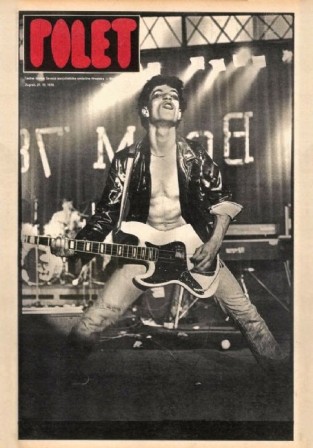
An infamous cover of Polet from late 1978 featuring Paraf's bassist, Zdravko Čabrijan performing at the BOOM Festival in Novi Sad.
An early 1979 Polet interview with the band, conducted by Sven Semenčić, offers a glimpse into their attitude toward the compromises that might be required to get into the studio. Asked whether they would be willing to alter their lyrics, the band responded: [4]
|
Original Croatian No, da dođemo do prilike za snimanje i da nam oni sugeriraju da još peremo tekstove, na to ne bismo pristali. U tom slučaju mirne duše ne trebamo nikada ni snimiti ploču. Svirat ćemo okolo i dobro se zabavljati. Ne zavaravamo se nekim tripovima o životnoj vezanosti za muziku (pa dakle, i egzistenciju od nje), jer ne želi kompromise. |
English Translation No, if it came to the point of getting a chance to record and them suggesting that we polish the lyrics even more, we wouldn't agree to that. In that case, we can peacefully never record an album. We'll just play around and have a good time. We're not fooling ourselves with some notions of being life-bound to music (and therefore, making a living from it), because we don't want to compromise. |
In the end, Paraf's first full-length album, A Dan Je Tako Lijepo Počeo, appeared in June 1980, but not without the compromises they had rejected in 1979. The album underwent changes to its cover art and lyrics, while certain tracks, such as "Goli Otok" which referenced the regime's gulag styled prison island for dissidents were removed from the final track list. [5] Even after these concessions, it was subjected to the so-called šund tax.
For punk, post-punk, and new wave, one of the more consequential forms of cultural regulation was the system colloquially known as the šund tax, administered by commissions responsible for determining what constituted šund. The term comes from the German Schund, meaning rubbish or inferior material, and became associated with a Yugoslav tax and cultural-regulation system that developed in the early 1970s. Initially aimed at material considered low-value or "kitsch" culture, including certain romance novels, crime fiction, periodicals, and new folk music, the system eventually encompassed rock and other forms of youth-oriented popular music deemed to have little cultural or social value. Bands such as Prljavo Kazalište, Idoli, U škripcu, Pankriti, Paraf, and Riblja Čorba, amongst many others, were hit with such taxes. [6]
The origins of this system, however, were more complicated than the term šund might suggest. From the perspective of tax policy, gramophone records had long been treated as ordinary consumer goods rather than as a privileged form of cultural production. As such they were subjected to potential turnover sales taxes ("Porezi na promet") across the country's decentralized taxation system. From the 1950s onward, Jugoton, and later PGP RTB, repeatedly sought to have the production of culturally valuable records treated more like the production of valued books. They argued in particular for preferential treatment for records containing classical music, literary works, language courses, and other material that could be understood as having a broader educational or cultural function. [7]
The important change, at least for music releases, came in the early 1970s, when legislation established the principle that products possessing "special social and cultural value" could be exempt from turnover tax. Rather than simply asking whether a cultural product was taxable, the system increasingly required authorities to determine which products deserved the privileged status of being considered socially and culturally valuable. The authorities responsible for making these determinations consequently became an important part of the system.
A contemporary municipal regulation from Lopare municipality in 1972 illustrates how this distinction operated in practice. Službeni glasnik Opštine Lopare, no. 7/72, included a tariff schedule in which Tariff No. 3 imposed a 15 percent special municipal turnover tax on gramophone records insofar as they were subject to the basic turnover tax. Tariff No. 4 also applied a 15 percent municipal rate to books, brochures, newspapers, magazines, and other daily and periodical informational and professional publications when they were subject to the basic turnover tax. Crucially, however, it exempted these printed materials from the municipal turnover tax if the publisher obtained, before putting them into circulation, an opinion from the competent republican or provincial authority that they were of "special social and cultural value". This was a municipal-level tax layered onto the broader turnover-tax system, which also included federal and republican rates. The 15 percent cited here therefore represents the municipal component rather than the total tax that could ultimately be applied to a cultural product. [8]
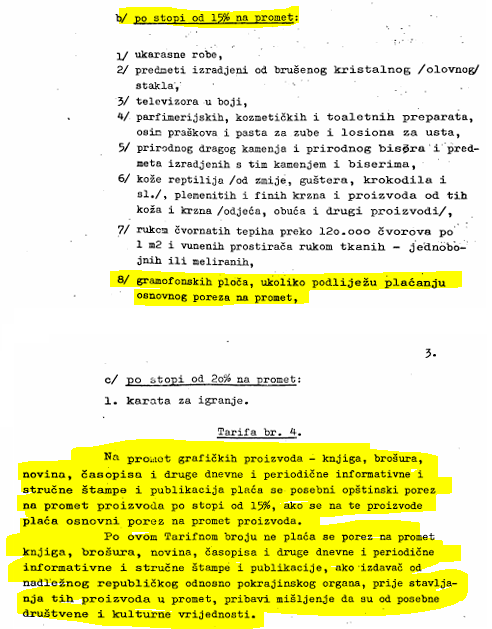
The relevant sections in Lopare's Službeni Glasnik mentioned above
As such, the mechanism of šund was, at least in theory, somewhat different from an outright ban. Rather than simply prohibiting a cultural product, the system could impose a slow bottlenecked process and impose a much higher sales tax on products judged to have insufficient social or cultural value. Products deemed to possess "special social and cultural value" could be exempt from the tax, while those classified as šund were subject to the applicable federal, republic, and potential municipal taxes. The combined tax could increase the retail price of a product significantly, placing a higher financial burden ultimately on consumers. By the mid to late 1970s, the Socialist Republic of Croatia had a turnover tax rate of 36.5%, in addition to a 14.5% federal rate. [9 p. 196] In some cases, the tax could be as high as 100%, as it was in the Socialist Republic of Macedonia. [10]
The decisions were made by commissions established within the individual republics. These commissions were responsible for determining which cultural products qualified for the preferential treatment and which would instead be classified as šund. In practice, this meant that the system could function as a form of indirect cultural regulation. A book, record, or other cultural product did not necessarily have to be prohibited from sale to be discouraged. Making it substantially more expensive could limit its audience and reduce its commercial viability. The broader cultural-policy establishment was itself cognizant of this mechanism's effects. In a 1982 cultural-policy document, Croatian cultural-policy authorities noted that "It was only the law on encouraging valuable achievements by exempting them from taxes that reduced the production of low-quality songs". [9 p. 191]
The video below (sorry, non Serbo-Croatian speakers) provides a few examples from artists who had records classified as šund such as Aerodrom, Zabranjeno Pušenje, and Prljavo Kazalište, as well as conveying some interesting anecdotes about other forms of censoring or concession making. [11]
A couple of interesting moments in the mini-documentary include:
-
Jura Pađen of Aerodrom mentions delays releasing 1984's Dukat i Pribadače album due to potential lyrical concessions and bottlenecks with the šund commission and label officials.
-
He claims the song "Sedam Milja Iznad Mora" was contentious with the commission due to a lyric with anti-military and anti-authority themes:
Original Croatian
Ja više ne bojim se
živjeti bez pameti
Ne treba mi škola,
odlazak u vojsku
i roditeljski savjetiEnglish Translation
I'm not afraid
to live without a mind
I don't need school,
going to the army
and parental advice
-
He claims the song "Sedam Milja Iznad Mora" was contentious with the commission due to a lyric with anti-military and anti-authority themes:
-
Darko Glavan, who was part of a commission during the new wave era, relays some insights into how the system actually operated:
- His account confirms much of the tax mechanism described above: the commission's role was not necessarily to declare a work šund, but rather to determine whether a work qualified as being of sufficient cultural value to receive preferential tax treatment and thereby avoid the additional taxes.
- He describes the review process as relatively cursory, with musical reviewers sometimes listening to only 20–30 seconds of a track while reviewing the lyrics associated with the release.
- He notes that if something was discovered, it would be discussed by the commission, although he does not clarify if "interesting" means something positive or negative.
- He claims that one of his greatest merits or accomplishments while on the commission was convincing other members of the authority that Azra's 1981 record Sunčana Strana Ulice was not rubbish despite several explicit political comments due to Johnny Štulić's "strong authorship" and "authentic effort", which apparently saved the record from the šund tax.
- Before his time on the commission, Prljavo Kazalište's first album was not declared to be of cultural value, reportedly because its lyrics made it clear that the band members were not "Tito's pioneers". They also lost out on an award after an incident in which their bassist at the time, Nino Hrastek, sang "Vila Velebita" at a party. The 19th-century Croatian patriotic song had acquired strong associations with Croatian nationalism during the Yugoslav period, and its public performance could therefore attract official suspicion, particularly during periods when Croatian nationalism was being aggressively suppressed.
- Davor Sučić of Zabranjeno Pušenje discusses lyrical compromises on some of their albums:
- "Dan Republike" from 1987's Pozdrav iz zemlje Safari had to have lyrical changes making a lyric less intense. The line "Svi cekaju pašos da odu van" ("Everyone's waiting for their passport to go away") was edited to remove the word "Svi" ("Everyone"), which led to hastily edited record sleeves that can be seen 13:45 in the video.
- The "Crko Maršal" affair became one of the more notorious examples of the band's run-ins with the authorities. During a 1984 concert in Rijeka, singer Nele Karajlić announced that an amplifier had stopped working by shouting, "Crko Maršal!" ("The Marshal's dead!"), immediately adding that he meant the amplifier. The joke was understood as a reference to "Maršal" Josip Broz Tito, who had been Yugoslavia's president and leader until his death in 1980, and it triggered a major backlash against the band, including canceled concerts and pressure from state institutions. Interestingly, Sučić explains that the amplifier was not even a Marshall and that, in fact, it was actually a Vox, making the joke even more absurd in retrospect. The incident can be seen at approximately 16:40 in the video.
A particularly decisive dispute took place in 1979 between the Zagreb youth magazine Polet and the commission responsible for determining šund. Polet was the newspaper of the League of Socialist Youth of Croatia, but by the late 1970s it had developed a reputation for its coverage of youth culture and its enthusiastic promotion of the emerging punk and new wave scene. The magazine played an important role in bringing bands such as Prljavo kazalište and Azra, among others, to a wider audience and helped establish the emerging Zagreb scene as a significant cultural phenomenon. [12] When Prljavo Kazalište released its self-titled debut album in 1979, the commission did not exempt the record from the šund tax. Journalists at Polet, particularly Sven Semenčić, challenged the decision and questioned why the band's socially critical lyrics were considered inappropriate while records containing what they regarded as far more trivial material escaped the tax. As an example, Semenčić pointed to another record whose lyrics included the "absurd" lines, "What is the connection / when I don't even know her number / I'll buy two horses / I'm such a real horse," and questioned whether this represented a more appropriate contribution to Yugoslav socialist society than Prljavo Kazalište's songs. [13]
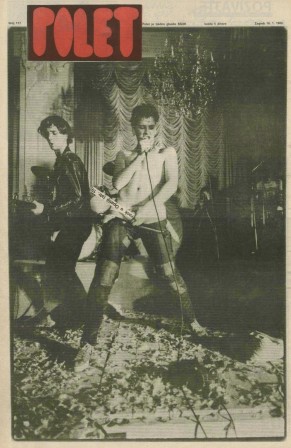
An example cover of Polet from 1980 featuring Termiti.
The criticism drew a response from Zvonimir Golob, a respected Zagreb poet and the chairman of the cultural commission that decided the merits of the release. Golob dismissed Prljavo Kazalište's album as a "...confused, dilettantishly played and sung record," describing its lyrics as "pseudorevolutionary, vulgar, and immature". His more substantive objection, however, concerned the band's portrayal of Yugoslav society. Golob took issue with the way the songs addressed bribery, corruption, lies, alcoholism, violence, and other social problems. He argued that the album presented a society in which "all the workers are drunks" and "nothing can be achieved without corruption", while offering only "false promises of a better tomorrow". He further characterized the band's depiction of society as one in which people "remember only beatings, only violence". [13]
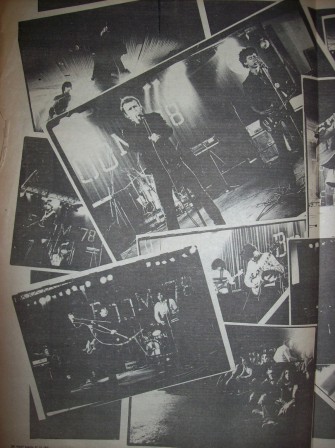
A page from Polet with pictures from the 1978 BOOM Festival which included Prljavo Kazalište.
The exchange is revealing because neither side was really arguing only about musical quality in the narrow sense of the term. Polet was challenging the commission over what kinds of social criticism should be considered legitimate, while Golob was defending a boundary between criticism of individual social problems and what he saw as an unjustified condemnation of Yugoslav society as a whole. A song criticizing corruption does not necessarily amount to a rejection of socialism, but a song or collection of songs portraying corruption, hypocrisy, violence, and failed promises as pervasive features of society could be interpreted as suggesting that the problem lay with the system itself. The Prljavo Kazalište dispute therefore provides a concrete example of the tension between the state's willingness to acknowledge and criticize social problems and its reluctance to accept cultural criticism that appeared to present those problems as systemic. In this case, the šund commission and its classification placed the record under the financial penalty of the tax, while the ensuing public dispute between the commission and Polet brought precisely the kind of attention to the band that the classification might otherwise have discouraged.
Prljavo Kazalište's ironic "U Mojoj Općini Problema Nema" ("There's No Problems In My Municipality"), off of their first šund hit record.
The Prljavo Kazalište dispute becomes even more significant when placed alongside the broader assessment of youth music made by the Croatian cultural-policy establishment only a few years later. The 1982 Crvena Knjiga ("Red Book") did not simply criticize individual songs or performers; it expressed a much broader suspicion of the emerging punk and new wave scene within the broader musical landscape of the republic. Its authors described contemporary rock and punk as suffering from a "lack of ideas and false rebellion", and insinuated that these Western derived genres had been "artificially grafted" onto Yugoslav society due to the work of private promoters and organizers. They associated the scene with "resignation" and "apathy," accused its adherents of creating a false form of nonconformism in the state. The document was particularly critical of lyrics that presented indifference toward society and the surrounding environment, while contrasting them with what it called the "revival" of patriotic and socially engaged music. [9, p. 192] The commission went on to complain that the punk and new wave scene had "systematically suppressed" other forms of youth music by dominating the youth press and other media disproportionately. This is particularly ironic given that the state was simultaneously trying to control the same scene through its own cultural institutions, including taxation, censorship, and active promotion of music it considered more acceptable. The Crvena Knjiga authors treated punk's popularity as a form of suppression in itself, while overlooking the power the state had in attempting to curtail the scene itself and failing to see how the scene was a spontaneous outlet for youth in the country.
In both cases highlighted above, the problem to the authorities was that persistent negative depictions of Yugoslav society could encourage audiences to view its problems as systemic rather than as isolated shortcomings. What the musicians could regard as straightforward observations or as artistic social commentary about their surroundings could therefore be interpreted by cultural authorities as evidence of "false rebellion" or hostility toward the social order. The commission, perhaps in a moment of tone deafness, wrote that, "Intolerance and exclusivity are most evident in the lyrics of these new punk bands (one example: one of our 'avant-garde' bands in one of their songs repeats the lines: 'bye-bye proletarians, the historical role has come to an end...')." [9 p. 193]
The song they quote in their prose is none other than Haustor's "Radnička Klasa Odlazi u Raj" ("The Working Class Goes to Heaven"). On its surface, the song is hardly an imported fantasy of Western alienation, nor is it in any way portraying a sense of exclusivity in the sense the commission referenced it as. Its title itself invokes the working class, while its subject is closely tied to a very real feature of Yugoslav life during the time in the large amount of workers leaving the country in search of better opportunities abroad. By the end of 1985, an estimated one million Yugoslavs were living abroad as external migrants, approximately 600,000 of them workers and 400,000 family members. [14] The song's workers are not alienated because they have been exposed to Western consumer culture, they are quite literally getting on a train and leaving. Yet this kind of observation sat uncomfortably alongside the official insistence that the working class remained the central social force of Yugoslav socialism. The song's bleakness could therefore be heard as precisely the sort of "resignation" and "apathy" that the Crvena Knjiga complained about, even though the reality it described was hardly imaginary given declining standards of living, skyrocketing inflation, and the malaise of corrupt self management schemes. [15]
Haustor's "Radnička Klasa Odlazi u Raj" ("The Working Class Goes to Heaven")
|
Original Croatian
Bolje je da odete, prilike su nove
Pa-pa, proleteri |
English Translation
You better leave, opportunities are new
Bye-bye, proletarians |
A song could be understood by its creators and audience as commentary on everyday life while being interpreted by officials as evidence of a broader anti-system attitude. Looping back to the Paraf interview in Polet mentioned earlier in the article, the band approached exactly this topic. When asked about the sensitive nature of their lyrics, the band stated: [4]
|
Original Croatian
To su istinite činjenice, ... A s politikom nemamo blage veze, niti nas ona i najmanje zanima. Zanima nas jedino ono s čim se suočavamo iz dana u dan u ovoj našoj čudnovatoj Rijeci, a vjerujem da tu ima mnogo zajedničkoga s mladima u cijeloj Jugi. |
English Translation
These are true facts, ... And with politics, we don't have the faintest clue, nor does it interest us in the slightest. We care only about what we face day in and day out here in our peculiar Rijeka, and I believe young people all over Yugoslavia share a lot in common in that regard. |
Despite claiming not to know a thing or two about politics, the members of Paraf had a very clear picture of the position of youth within Yugoslavia at large, and it would not be a stretch to claim that their pulse on the situation was more in line with reality than those in the cultural authorities who authored the Crvena Knjiga a few years later. Paraf's insights correlate quite well with the broader political alienation of Yugoslav youth, as evidenced by the declining share of young people expressing a desire to join the League of Communists as well as a steady drop in the share of youth participation in the League of Communists during the 1970s and 1980s. [16]
Lenard J. Cohen's Broken Bonds gives us some information that can be a proxy for the growing political apathy of the youth in the country. The source cites a longitudinal data sources around youth in the country. The first table looks at the proportion of young people surveyed in 1974, 1986, and 1989 around their desires to join the League of Communists across all of Yugoslavia:
Proportion of Young People Surveyed NOT Wishing to Join the League of Communists
| Year | Proportion of Youth |
|---|---|
| 1974 | 9% |
| 1986 | 50% |
| 1989 | 51% |
This data can further be broken down for the years available by republic and province, showing directional trends across republics, but also highlighting the degree varies between them:
Proportion of Young People Surveyed NOT Wishing to Join the League of Communists by Republic and Province
| Republic / Province | 1974 | 1986 | 1989 |
|---|---|---|---|
| Slovenia | 32% | 88% | 92% |
| Croatia | 13% | 70% | 75% |
| Vojvodina | 4% | 54% | 50% |
| Serbia | 6% | 40% | 42% |
| Macedonia | 7% | 40% | 42% |
| Bosnia and Hercegovina | 5% | 36% | 40% |
| Kosovo | 4% | 35% | 33% |
| Montenegro | 8% | 18% | 34% |
It is important not to overstate the effectiveness of the šund system because many of the records discussed here in fact do survive, found audiences, and have since become an important part of the historical record. Some musicians even came to wear the šund designation as a badge of honor, and records classified with the tax could still sell well despite the additional cost. Paraf's debut even sold out completely in its first pressing, for example, even with the tax and being delayed for many months. [17] Despite this, we shouldn't subscribe to a form of survivorship bias when looking back at the period in general. The bands and records we can identify today are, by definition, the ones that managed to make it through the system in some form or another. The more difficult question is what was completely discouraged, delayed indefinitely, altered without a story, fully abandoned, or never recorded in the first place. A record that eventually sold out despite being taxed tells us that the tax did not make success impossible, but it does not tell us what might have happened had the financial and institutional barriers not been there. The opportunity costs are much harder to measure, but they are also an important part of understanding how the system affected cultural production.
The history of punk, post-punk, and new wave in Yugoslavia therefore looks less like a simple story of censorship and more like a continual negotiation over what kinds of criticism the socialist state was willing to tolerate. The šund system, or "rubbish tax", provides an example of this process where, rather than simply banning undesirable music, authorities could classify records as culturally inferior and subject them to substantially higher taxation, creating a financial and institutional barrier between musicians and their audiences. The experiences of bands like Paraf, Prljavo Kazalište, and Haustor reveal the limits of this distinction, as the musicians were often not attempting to make a direct political statement, yet their willingness to document the world around them could itself become politically significant. At the same time, the growing disengagement of Yugoslav youth from formal political institutions helps explain why this music resonated so strongly with its audience. What the Crvena Knjiga interpreted as apathy, resignation, and false rebellion could instead be understood as a generation increasingly skeptical of the institutions that claimed to represent it. In this sense, Yugoslav punk and what followed was not simply an imported Western subculture or a straightforward challenge to socialism; it was a distinctly Yugoslav response to the contradictions of a society that permitted considerable cultural openness while continuing to police the boundaries of acceptable criticism.
Sources
- 1. "Yugoslav Poet on Trial for Defaming Tito in Verse." Christian Science Monitor, 24 July 1981. Online Article
- 2. Jovićević, Aleksandra. "Censorship and Ingenious Dramatic Strategies in Yugoslav Theatre (1945–1991)." Primerjalna književnost 31, special issue (2008): 237–249. p. 243. PDF
- 3. Ramet, Sabrina Petra. Balkan Babel: The Disintegration of Yugoslavia from the Death of Tito to Ethnic War. 2nd ed. Boulder, Colo.: Westview Press, 1996. ISBN 978-0-8133-2559-8. p. 104.
- 4. Semenčić, Sven. "Mi nismo destruktivci." Polet, 7.2.1979. Reproduced in "PARAF - POLET JE KRIV ZA SVE (1978/79)," Stražarni Lopov. Digital reproduction
- 5. Lulić, Ivana. "Svježi, iskonski punk rock." Cantus, Hrvatsko Društvo Skladatelja, no. 214 (Ožujak 2019): 95. PDF
- 6. "Feljton: Hoćemo cenzuru! (3. dio) – jugoslavenski Zakon protiv šunda i porno folk." Ravnododna. Online Article
- 7. Ceribašić, Naila, Dora Dunatov, and Jelka Vukobratović, eds. Rana domaća diskografska industrija: Edison Bell Penkala, Elektroton i Jugoton. Zagreb: Institut za etnologiju i folkloristiku; Ljubljana: Založba Univerze v Ljubljani, 2025. PDF
- 8. Službeni glasnik Opštine Lopare, br. 7/72, 1972. "Tarifni broj 3" and "Tarifni broj 4." PDF.
- 9. Šuvar, Stipe, and Damir Grubiša, eds. Kulturna politika i razvitak kulture u Hrvatskoj: ("Crvena knjiga" i drugi dokumenti). Zagreb: Republički komitet za prosvjetu, kulturu, fizičku i tehničku kulturu; Republička samoupravna interesna zajednica u oblasti kulture; Zavod za kulturu Hrvatske, 1982.
- 10. "Ko određuje koja muzika je vrijedna slušanja: U bivšoj Jugoslaviji je to bila 'komisija za šund'." Klix.ba, 24 February 2023. Online Article
- 11. Druga Strana Rock and Rolla. YouTube. Video
- 12. Krušelj, Željko. Igraonica za odrasle: Polet 1976.–1990. Rijeka: Adamić, 2015. ISBN 978-953-219-500-2.
- 13. Vesić, Dušan. "'Crno bijeli svijet' lansirao je Prljavo kazalište na vrh." Nacional, 26 July 2020. Online Article
- 14. Nejašmić, Ivo. "Statistical Observation and Some Quantitative Characteristics of Yugoslav External Migration." Migracijske i etničke teme 3, nos. 3–4 (1987): 289–301, p. 301. PDF.
- 15. Ramet, Sabrina P. Nationalism and Federalism in Yugoslavia, 1962–1991. 2nd ed. Bloomington: Indiana University Press, 1992. ISBN 978-0-253-34794-4. p. 158.
- 16. Cohen, Lenard J. Broken Bonds: The Disintegration of Yugoslavia. 2nd ed. Boulder, Colo.: Westview Press, 1995. ISBN 978-0-8133-2811-7. p. 48.
- 17. "Vsi smo bili uporniki, z razlogom ali brez." Delo. Online Article